Seventy-nine outlets. Both of them. Barista Sri Lanka took about fifteen years to get there. Bing Chun took about fourteen months.
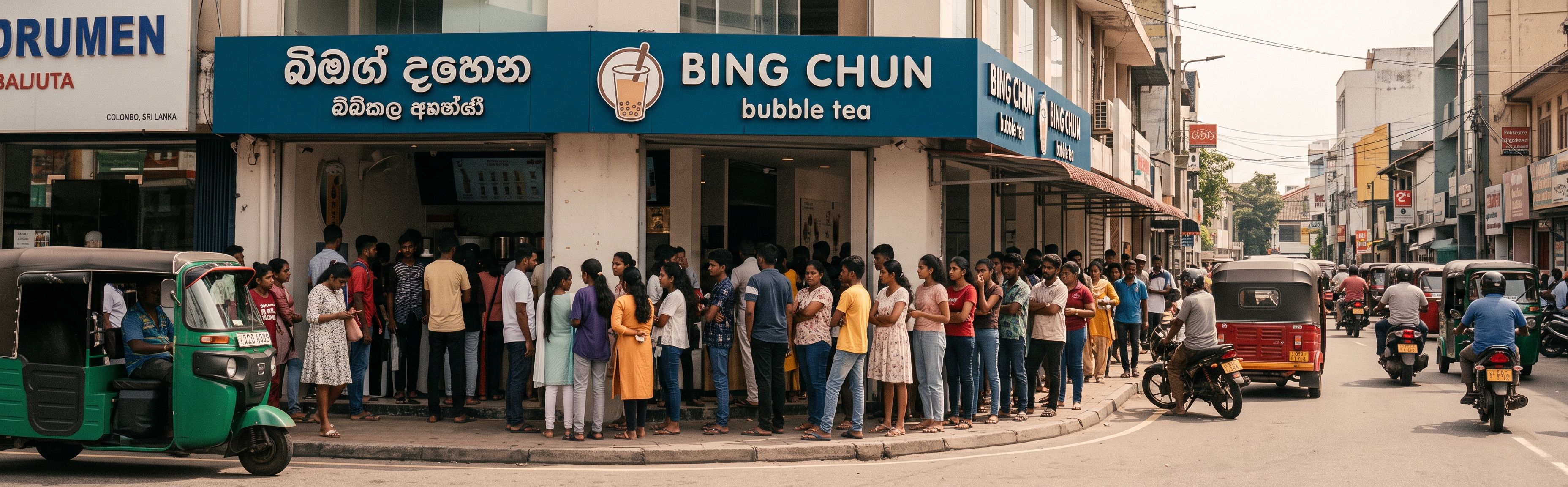
In roughly April or May 2025, a bubble tea and soft serve shop opened on Galle Road in Kollupitiya. Nobody announced it. There was no press release and no launch event that anyone recorded. The first public traces are Instagram posts from June and July 2025 describing a queue of fifty or sixty people outside a shop selling ice cream at two hundred rupees.
By June 2026, Sri Lankan business press was reporting the opening of Bing Chun's **seventy-ninth outlet**, inside a LAUGFS supermarket in Pepiliyana. In the same window, Perera and Sons, a company with two hundred and twenty-five outlets and a hundred and twenty-three years of history, was adding roughly fifteen to sixteen outlets a year. Barista Sri Lanka, in the best year it has ever had, added thirty-two.
This is the second Scale File, and it is the mirror image of the first. Barista showed you what happens when a company builds architecture and then grows. Bing Chun shows you what happens when a company **imports architecture that was already finished** and simply switches it on in a new country.
If you have product-market fit and four outlets, and you have been watching this brand appear on every second junction wondering how, this case is for you. But the answer is not the one you are expecting, and the more important question is not how they did it. It is who is carrying the risk while they do it.

The company that never conquered its own country
Start with what Bing Chun actually is, because almost everyone in Sri Lanka has it wrong.
Bing Chun, or 冰淳茶饮, is a tea chain owned by Henan Liangdi Catering Management Co. Ltd, headquartered in Xinxiang, Henan province. The first shop opened in 2012. The company was formally established in 2017. By August 2023 it had passed two thousand three hundred stores in China.
That sounds enormous until you place it. Mixue, the category leader from the same province, has more than forty-five thousand stores. Bing Chun is not a Chinese national champion. It is a **provincial operator that never won its own home market.** According to industry data platform 窄门餐眼, more than half of its stores are still concentrated inside Henan after fourteen years, and roughly seventy-two percent sit in townships rather than cities.
Read the company's own English-language website and it tells you exactly what it is, in language no Sri Lankan reader would think to take literally. Its stated vision is to become **the world's most valuable investment tea brand.** Its stated culture is to help young people in small towns realise their entrepreneurial dreams. Its eight internal service centres include a Supply Chain Centre and an **Investment Management Centre.**
This is not a Bing Chun peculiarity. It is the structure of the entire Chinese tea export wave, and it is documented in the one place the numbers had to be disclosed. When Mixue listed, its prospectus showed that franchise fees were roughly **2.4 percent** of revenue. Approximately **97.6 percent** came from selling ingredients, equipment and packaging to its own franchisees. Guming reported 79.5 percent from goods and equipment sales. Cha Bai Dao reported 94.8 percent.
Ray Hsu of Shenzhen venture fund RF Capital put it in one sentence to CKGSB: rather than a tea and ice cream brand, Mixue is essentially a supply-chain machine.
Bing Chun does not publish its revenue split. It is not listed and it files no audited public accounts. But it runs a self-built factory for core products, a dedicated Supply Chain Centre, and an Investment Management Centre, and it sells a franchise package in which the equipment line is roughly six times the franchise fee. You do not need the prospectus to read the architecture.
By the end of 2025 the group reported more than four thousand **signed** stores globally, of which over a thousand were overseas across twenty countries. By July 2026 it reported over four thousand five hundred signed, with roughly fifteen hundred overseas. Its first foreign markets were Vietnam and Laos in 2019, then Indonesia, Thailand and Malaysia.
They did not out-execute us. Execution was already finished.
Here is the part every Sri Lankan owner needs to sit with. Bing Chun did not out-execute local operators. It arrived with execution complete, paid for over fourteen years and two thousand three hundred Chinese stores, and spent its Sri Lankan year doing distribution rather than construction.
Look at what was already finished when the container landed.
**The store is twelve square metres.** That is the company's published minimum net usable area in China, alongside a minimum storefront sign height of 2.4 metres, minimum door width and interior depth of two metres, and a requirement for 380V three-phase power at 100 amps or above. Twelve square metres is not a café. It is a serving position with a person in it. It changes the lease universe, the fit-out cost, the staffing model and the payback maths all at once, and it opens locations no traditional Sri Lankan F&B operator would consider viable.
Most owners in this country design a shop they would be proud to be photographed standing in front of. Bing Chun designed a unit it could open eighty times.
**The labour is deliberately deskilled.** Bing Chun Sri Lanka's own careers page advertises shop assistants aged eighteen to thirty, friendly and team-oriented, with no experience needed because training is provided. There is a Junior Trainer role whose job is to travel between outlets maintaining standards, and a Renovation Supervisor whose job is to run fit-outs island-wide. Head office is in Colombo 03. Applications are by WhatsApp.
That is not a low-quality hiring policy. That is a design decision, and it is the one that makes store fifty possible. If your operation requires talent, you cannot open eighty of them, because talent does not scale at the rate leases do.
**The menu is permutation, not variety.** The Sri Lankan menu runs from a two hundred rupee soft serve up to six hundred and fifty rupee premium fruit teas, a spread of more than three times. But look at what is actually in the cups. Bubble teas, milk teas, fruit teas, milkshakes, sundaes and ice creams, built from a small set of tea bases, syrups, powders, dairy substitutes and toppings recombined. Almost nothing on that menu requires a raw material that is not already in the store for something else.
**The fit-out is an internal process, not a negotiation.** A company that employs its own Renovation Supervisor is not tendering each shop. It is running a repeatable build. That is why outlet seventy-nine looks like outlet nine, and why the gap between signing a lease and opening a door is measured in weeks.
**And the franchise terms are structured so that the franchisor is paid on opening day.** In China, the published package is roughly one hundred and thirty thousand yuan, promoted at ninety-nine thousand eight hundred. Inside that: a franchise fee tiered from six thousand eight hundred yuan in townships to sixteen thousand eight hundred in cities, a ten thousand yuan refundable deposit, around sixty thousand yuan of equipment, around twenty-three thousand yuan of initial materials, and twenty to thirty thousand yuan of fit-out.
The Thailand package, published by franchise listing sites, runs to roughly eight hundred and forty-five thousand baht, of which the annual franchise fee is fifty thousand and the equipment alone is four hundred and fifty thousand, with two hundred thousand of first ingredients on top.
In both markets the franchise fee is trivial and the hardware and inventory are the business. That is Mixue's 97.6 percent structure visible in the invoice line items rather than in a prospectus.
So when a Bing Chun store opens in Kurunegala, ask the question that matters. Who has already made money that day?
Why people come back, and who owns the reason
Bing Chun has no app, no loyalty card, no points programme and no customer database. At seventy-nine outlets. In 2026.
The obvious reading is that this is a gap they have not got to yet. The obvious reading is wrong, and understanding why is the most valuable thing in this case study.
**Start with the two hundred rupee soft serve.** Two hundred rupees sits below the threshold at which a Sri Lankan consumer deliberates. There is no consideration phase to win, no comparison to survive, no reason to think about it. That is not a cheap product. It is an acquisition cost booked as a menu item.
**Then the queue.** Bing Chun's opening posts run the same mechanic every time: free ice cream with any beverage purchase on opening day. The queue on day one is bought deliberately, at the cost of the giveaway margin. And a queue is the one creative asset a company cannot buy and does not have to. Nobody films a beverage counter. Everybody films fifty people standing outside one.
In a sample of Sri Lankan social posts and comments about Bing Chun across Instagram, Facebook, X and YouTube, queue and social experience was the single largest category, running from June 2025 through 2026. The company's biggest marketing asset is a line of people, and it does not pay for it.
**Then the part almost nobody notices.** There are outlet-level social accounts, run by individual outlets, posting in Sinhala. One Negombo account announced its own opening with 🚨 මීගමුව, අපි OPEN. The franchisee is producing the content, in the local language, at their own cost.
And the same content does two jobs. A customer scrolling sees a drink. A prospective investor scrolling sees a fifty-person queue, which is demand validation he did not have to pay a consultant to produce. One content spend, two conversions. The consumer funnel and the franchise recruitment funnel are the same funnel.
Criticism feeds it too. Sri Lankan commenters have said the drinks are rubbish, that the queue is absurd, that price reflects quality. At two hundred rupees, quality criticism does not deter trial. Every complaint carries the brand name and the price point to a new audience.
What is actually happening in the cup
Watch someone finish one of these drinks. They do not put the cup down. They keep working it, sipping the melted ice, chasing something. That behaviour is not enjoyment. It is a person pursuing a reward that has just been withdrawn.
**Cold hides the dose.** Sweet taste perception is temperature dependent and is suppressed at low temperature. A beverage engineered to be consumed ice cold can therefore carry a sugar load that would be rejected outright at room temperature. The palate never registers the dose as excessive.
**The reward curve rises as the supply runs out.** As the ice melts and the cup warms in the hand, perceived sweetness increases even as actual concentration falls through dilution. The last third of the cup tastes sweeter than the first. The pull is strongest exactly when there is least left.
**The peak and the end are the same moment.** Tapioca pearls sink. The final mouthfuls carry the highest concentration of chew and sugar in the whole serving. People remember an experience by its most intense moment and its final moment, and this cup arranges for those to coincide. The memory encoded is better than the average experience justifies.
**Nothing signals that you have eaten.** Liquid calories register poorly against satiety regulation. The stomach can be satisfied while the reward system is not. Those are two different systems, and this product addresses one and ignores the other.
**And the want arrives on a timer.** A high glycaemic load produces a trough roughly forty-five to ninety minutes later that presents subjectively not as a memory of the drink but as a physical wanting. Which raises the only question that matters commercially. Where is the customer standing when that lands?
Here is where the product meets the property strategy. Bing Chun's published territorial guidance in China asks franchisees to site new stores at least **three hundred metres** in a straight line from an existing store. Three hundred metres. Any franchisee would call that cannibalisation, and in a supply-chain frame it plainly is, because the franchisor is paid per unit supplied rather than per unit profit.
But read it behaviourally and it is something else entirely. Three hundred metre spacing means the craving arrives inside a conditioned cue field. The trough lands, the customer looks up, and a storefront is there, with a queue outside it delivering social proof at the precise moment of physiological vulnerability.
Which corrects the obvious reading of the missing app. Bing Chun did not skip customer retention. It made software unnecessary, by building the return into the product and the reminder into the store estate. They did not build retention. They built **recurrence**, and recurrence is cheaper to run because it has no monthly cost at all.
That is the most sophisticated thing this company has done, and it deserves to be said plainly rather than sneered at.
It is also where the exposure sits. A relationship is owned. A craving is not. The habit here attaches to sugar, cold, price and proximity, and every one of those four can be replicated by anyone with a shipping container and a lease. The franchisee has bought a position in a cue field that a competitor can occupy by taking the shop next door.
The case nobody in Sri Lanka is making
There is a second case study inside this one, and for a Sri Lankan business owner it is the more important of the two.
Sri Lanka has **no franchise statute, no franchise registry, no regulator with franchising in its remit, and no statutory pre-contract disclosure obligation of any kind.** Franchise agreements are ordinary commercial contracts governed by contract law and the Intellectual Property Act No. 36 of 2003.
Now compare. Under Malaysia's Franchise Act 1998, a foreign franchisor must register the franchise, must obtain separate approval under Section 54 to sell franchises in the country, and must hand the prospective franchisee a prescribed disclosure document **including three years of audited accounts** at least ten days before signing. Failing to do so is a criminal offence. Indonesia requires registration with the Ministry of Trade and pre-contract disclosure of financial information under Government Regulation No. 42 of 2007.
This is not an accusation against Bing Chun or anyone selling its franchises. They are complying fully with Sri Lankan law, because Sri Lankan law asks for nothing. It is an observation about the market every reader of this article operates in, and it explains why we could not find a Sri Lankan operating entity, a director list, or a single published franchise term. Nothing requires any of it to exist.
So the Sri Lankan franchisee has to do the work the state does not. Which means doing the arithmetic the sales conversation will not do for you.
Bing Chun's parent tells prospective franchisees that raw material cost is held **within thirty-five percent.** That figure is calculated on Chinese domestic input prices. It does not survive the journey.
Sri Lankan import taxation compounds. Flavoured beverage preparations can carry customs import duty around twenty percent, PAL around ten percent, CESS of up to forty-five percent or a specific per-litre rate, SSCL at 2.5 percent and VAT at eighteen percent, each layered onto a cumulative base. Powdered beverage bases, non-dairy creamers and tapioca pearls typically fall in a ten to twenty percent duty band with the same para-tariff stack on top. Commercial food service equipment sits around ten to fifteen percent duty before the rest.
Then the currency. The rupee moved from roughly two hundred and ninety-five to the dollar in January 2025 to around three hundred and thirty-three by August 2026, and from about 40.2 to the yuan to roughly 44.5. That is an eleven to thirteen percent depreciation across precisely the window in which this network was built. The imported cost base rose by that much in rupee terms while the shelf price stayed at two hundred rupees.
Model it yourself. Take a twenty square metre outlet. Rent on a secondary Colombo frontage at around two hundred rupees per square foot is roughly forty-five to sixty-five thousand rupees a month, and prime Galle Road frontage at three hundred to five hundred rupees per square foot is sixty-five to a hundred and sixty thousand. Four staff at thirty-five thousand rupees is a hundred and forty thousand, plus fifteen percent in EPF and ETF employer contributions, which is another twenty-one thousand. Add utilities for three-phase power running soft serve machines and freezers fourteen hours a day.
That is roughly two hundred and ninety thousand to four hundred and thirty thousand rupees of fixed cost a month before a single cup is sold.
At an average ticket of three hundred and fifty rupees and the franchisor's claimed thirty-five percent material cost, contribution is about two hundred and twenty-seven rupees a cup, and breakeven on fixed cost is roughly **forty-five to sixty-five cups a day.** Comfortable. That is the number the sales conversation runs on.
Now correct for Sri Lankan landed reality. If the tariff stack and the currency move push effective cost of goods to fifty-five or sixty percent, contribution falls to roughly a hundred and forty to a hundred and fifty-eight rupees, and breakeven rises to **seventy-five to a hundred cups a day.** That is before a single rupee goes toward the equipment invoice, the fit-out, the three to six months of advance rental that Sri Lankan commercial landlords routinely require, or the owner taking anything out for themselves.
A hundred cups a day is achievable at a queueing Colombo site. It is a materially different proposition at a site with a fraction of that footfall, carrying the same equipment invoice. And under a three hundred metre siting rule, the franchisees who sign later get the thinner sites.
Bing Chun through the five pillars
Everything above is narrative. This is the part you can act on. At Elara we assess a company across five pillars. They are not a checklist. They are load-bearing, and a business collapses through whichever one is weakest regardless of how strong the others are.
Bing Chun is instructive because it is close to perfect on three pillars, deliberately absent on one, and carries its entire risk in the fifth.
Financial Structuring
For the franchisor, this is close to flawless. Growth is funded entirely by franchisee capital. The equipment invoice, the fit-out and the first inventory order settle the franchisor's return on the day the door opens, before a single customer has been served. There is no balance sheet exposure to a bad site, a bad operator or a bad year.
For the franchisee, the same structure reads very differently. A rupee-denominated revenue line sits against a dollar and yuan-denominated cost base, in a country that defaulted on its sovereign debt four years ago and has previously restricted imports when reserves tightened. The franchisee carries the currency risk, the tariff risk, the site risk and the novelty risk. The franchisor carries the shipping.
Barista Sri Lanka did something structurally similar and got a different result, which is worth understanding. It also pushed capital expenditure onto franchisees. But it did so after fifteen years of operating the brand in this market, with published payback expectations, and with its own area management accountable for franchisee profitability. The structure is not the problem. The sequencing and the accountability are.
People and Culture
Strong, and deliberately so. Age eighteen to thirty, no experience required, training provided in-house, one travelling Junior Trainer maintaining standards across the estate. Nothing in the operating model depends on a skilled individual, which is precisely why the model can be replicated eighty times in a year.
The uncomfortable mirror for most readers of this article is that your business is built the other way around. It depends on one or two people who cannot be replaced, and you call that quality. It is not quality. It is a ceiling.
Where the model is thin is above store level. Compare Barista, which puts an area coach on every store including franchised ones, personally accountable for that franchisee's revenue and profit. We could find no equivalent structure here, no named Sri Lankan operating company, and no publicly identifiable local management beyond a head office address and a WhatsApp number.
Operational Excellence
This is the pillar Sri Lankan owners should study hardest, because it is the one that is free to copy.
A twelve square metre minimum footprint. An in-house Renovation Supervisor turning fit-out into a repeatable internal process rather than a per-site negotiation. A menu of thirty or more items built from a small shared set of bases, syrups and toppings. Standard opening hours across every outlet, nine in the morning to eleven at night. Standardised preparation using pre-portioned inputs so that output does not vary with who is on shift.
Consistency here is engineered upstream so that it cannot fail downstream. That is the opposite of the Sri Lankan default, which is to engineer consistency by having the owner walk in unannounced.
Technology Injection
Almost nothing, and this is the finding rather than the gap. No app, no loyalty programme, no customer relationship management, no owned customer data. Franchise recruitment and job applications both run through WhatsApp.
Episode one of this series showed Barista installing an enterprise platform in 2007 on top of unit economics that did not work, and getting a faster, better-documented view of its own losses for another decade. Technology amplifies whatever sits underneath it.
Bing Chun has not made that mistake. It has done something more interesting. It has made the technology unnecessary, by relocating the retention job into the product and the store estate. Pillar four is not missing here. It has been substituted.
The cost of that choice is that the company owns no customer data, no direct channel, and no relationship it can activate when the queue thins. It has recurrence and it has no way to defend it.
Demand and Revenue Engine
The most impressive pillar and the most fragile. An entry price below the deliberation threshold, a manufactured queue that generates free content, franchisee-funded local marketing in local languages, a product engineered for return rather than for approval, and a store estate spaced to deliver the reminder.
Note what this engine does not produce. It does not produce a reason to prefer Bing Chun over an identical product at an identical price two doors down. Demand here rests on price, novelty, proximity and physiological pull, and none of those four is proprietary.
One leading indicator is already on the record. In June 2025, barely a month or two after the Kollupitiya outlet opened, a Sri Lankan user posted that the shop he had always seen with a line of fifty or sixty people was, that day, empty.
Deployment is not compounding
Deployment is opening units. Compounding is units that pay back and fund the next unit. They look identical from outside for about two years, and then they do not.
Barista Sri Lanka spent roughly fifteen years reaching seventy-nine outlets, and the shape of that curve matters more than the endpoint. It sat at seven or eight outlets for sixteen years, rebuilt its architecture from 2018, and only then accelerated, adding thirty-two outlets in 2025 alone. The slow years were not wasted years. They were the runway.
Nothing in this case study says the Bing Chun architecture is bad. It is superb, and Sri Lankan owners should study the twelve square metre format, the permutation menu and the deskilled role until they can draw them from memory. Every one of those is available to you and none of them requires foreign capital.
What this case study says is narrower and harder. The architecture belongs to Xinxiang. The lease, the equipment loan, the currency exposure and the staff contracts belong to Kurunegala. In a country with no disclosure regime, the party who understands that difference is the party selling the equipment.
And there is a specific test coming. If queue formation holds through 2027 and outlet-level traffic sustains without any loyalty mechanism, our reading that this is recurrence without ownership will need revisiting. If traffic decays first at the highest-density clusters, the cue field reading is confirmed. Either way the answer arrives within twelve months, and it will be visible on the street rather than in a filing.
The idea we would give them
Bing Chun's entire Sri Lankan cost base is imported. Sichuan lemons, Fujian tea, Chinese equipment, Chinese packaging, all purchased in hardening currencies and sold for rupees on an island that grows tea, dairy, coconut and tropical fruit at export quality and has a functioning food processing base.
The obvious move, and we offer it publicly and without charge, is to stop treating Sri Lanka as a demand market and start treating it as the sourcing and blending hub for South Asia. Localise the tea base, the dairy and the fruit. Convert the single largest structural risk in the operation into the one advantage a competitor with a shipping container cannot replicate.
That idea is worth more to them than this article costs us to write, and we would rather it were built than owned.